Lucy’s Custard Shop Gets Three Specialized Custard Machines Installed in East Vancouver
When Lucy’s Custard Shop decided to expand their dessert menu in East Vancouver, they did not just place an order and plug things in. They imported three specialized custard machines from the United States, each one requiring careful planning, custom HVAC and refrigeration connections, and a commercial installation that would meet health code standards and keep the product flowing day after day.
What Lucy’s Custard Shop Needed
Lucy’s Custard Shop is the kind of place that draws people in from all over East Vancouver. Frozen custard is different from regular ice cream. It is denser, creamier, and served at a slightly warmer temperature so the flavor comes through stronger. But making frozen custard at commercial scale takes specialized equipment that most standard ice cream machines cannot handle.
The owners brought in three custom custard machines direct from a U.S. manufacturer. These are not off-the-shelf units. Each machine has its own refrigeration circuit, condenser requirements, and ventilation needs. You cannot just set them on the counter and turn them on. They need dedicated condensing units, proper refrigerant lines, and the kind of commercial HVAC integration that keeps everything running at the precise temperatures frozen custard demands.
“We knew the machines themselves were top quality,” said Lucy’s owner. “But getting them installed right was the part we did not want to mess up. Custard is finicky. If the temperature is off by even a degree, the texture changes. We needed someone who understood refrigeration and commercial HVAC, not just somebody who could hook up a few pipes.”
Why These Machines Needed Commercial HVAC Support
Each of the three custard machines operates with a remote condensing unit that rejects heat through the roof. That is where Air Solutions Mechanical came in. Installing custard machines of this caliber involves more than dropping them into place. Here is what we had to work with:
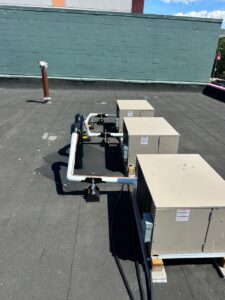
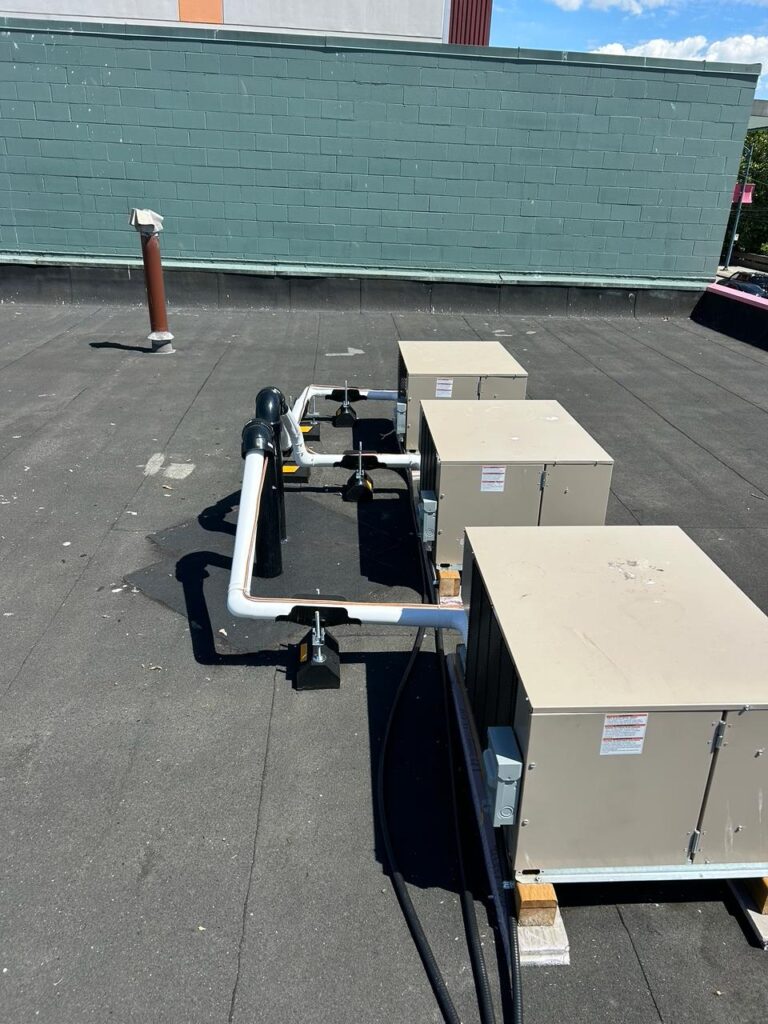
- Three beige condensing units mounted on the flat dark-gray rooftop
- White refrigeration lines running between each unit and its corresponding machine
- Black control wiring for temperature regulation and system monitoring
- A dark green brick wall providing the backdrop
- One existing brown vent pipe on the left side of the installation zone
The layout looks clean and professional from above, but getting it that way took real planning. Each condensing unit had to be positioned for proper airflow and service access. The refrigerant lines had to be sized correctly and insulated to prevent temperature loss. The control wiring had to be run cleanly so the machines could communicate with their rooftop partners without electrical interference.
This is not the kind of job a general contractor handles. It takes a commercial HVAC and refrigeration crew who knows how to size linesets, charge refrigeration circuits, and commission multi-unit systems from scratch. For property managers and food service owners facing similar challenges, we offer emergency repairs and full service contracts to keep equipment running year-round.
How We Installed Three Specialized Custard Machines
Assessing the Rooftop Layout
The first thing we did was walk the roof. The flat dark-gray surface gave us plenty of room, but we needed to place the three condensing units so they would not recirculate hot air into each other. That is a common mistake with multi-unit installations that we see during many of our commercial refrigeration retrofits. When units are packed too tight, they pull in each other’s discharge air, which raises head pressure and kills efficiency.
We spaced the three beige units evenly across the roof, each one aligned for straight refrigerant line runs down into the shop below. The existing brown vent pipe stayed clear of all three units, so there was no conflict with exhaust or combustion air.
Running Refrigeration Lines and Controls
With the condensing units positioned, we ran the refrigeration lines from the roof down to the custard machines inside the shop. Each machine got its own dedicated lineset sized specifically for its refrigeration load. White insulation jackets protect the suction lines so the cold refrigerant arrives at the machine without picking up heat along the way.
Black control wires connect each condensing unit to its machine thermostat. This allows the system to cycle on demand. When the custard machine needs cooling, the condensing unit fires up. When it reaches temperature, it shuts down. No wasted energy.
Testing and Commissioning Each Machine
After the lines were run and the wiring was landed, we pressure tested every circuit. Refrigerant leaks are the enemy of any commercial refrigeration system. A slow leak means the machine loses capacity, the custard texture changes, and the compressor runs longer than it should. We followed ASHRAE commercial refrigeration standards throughout the process. We held pressure on each circuit, confirmed zero leakage, then pulled a deep vacuum to remove moisture.
Then we charged each system with the correct refrigerant type and weight. Not a guess. Not “close enough.” We measured and weighed every charge so each machine operates exactly as the manufacturer intended.
Cool Custard, Happy Customers
The results speak for themselves. Lucy’s Custard Shop now has three fully operational custard machines producing product at the consistent temperature frozen custard demands.
“We have been running full speed since the install,” the owner told us. “Every batch comes out exactly the same. That is what we were hoping for. We did not want to be a shop that has good custard some days and okay custard other days. We wanted every single serving to be perfect. And now it is.”
The rooftop installation handles the heat rejection without any issues. The three condensing units cycle on and off independently, so if one machine is idle, only that unit shuts down. The others keep working. This saves energy and extends the life of each compressor.
For the shop itself, the custard machines sit in a clean, organized setup. The refrigeration lines disappear into the ceiling, the condensing units hum quietly on the roof, and the product stays cold and consistent.
What Food Service Owners Can Learn
If you run a restaurant, bakery, ice cream shop, or custard stand, there are a few things worth taking away from this project.
Specialized equipment needs specialized installation. You cannot run a commercial custard machine through a standard outlet and expect it to perform. These units require dedicated refrigeration circuits, proper ventilation, and professional commissioning. Cutting corners on the install means cutting corners on the product.
Commercial refrigeration and HVAC go hand in hand. The condensing units on the roof are doing the same job a commercial HVAC system does: moving heat from one place to another. The same skills that apply to a rooftop unit repair apply to a custard machine install. Heat transfer is heat transfer, whether it is cooling a showroom or cooling a batch of custard.
Plan your rooftop layout before you buy equipment. A good commercial HVAC contractor can look at your roof and tell you where units should go, where lines can run, and how to avoid problems before they start. We did that on this project and the result is a clean, serviceable installation that will work for years.
Use a contractor who knows the equipment. We dealt with customs clearance on three machines imported from the USA. We matched U.S. manufacturer specs to Canadian electrical and refrigeration standards. That kind of cross-border coordination takes experience.
Need Commercial Refrigeration or HVAC Installation in East Vancouver?
Air Solutions Mechanical Ltd. handles commercial HVAC and refrigeration projects of all sizes across the Lower Mainland. Whether you need condensing units on your roof or a complete commercial HVAC system for your shop, restaurant, or retail space, we have the experience to get it done right.
We work with equipment imported from the USA, Canada, and anywhere else your business needs. We understand refrigeration circuits, heat rejection, and the importance of doing the job right the first time.
Give us a call. Let us handle the mechanical side so you can focus on serving your customers.